|
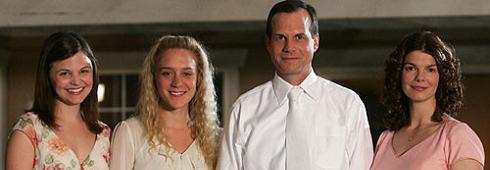
HBO has a pretty good track record of creating original series that audiences become incredibly passionate about. In the past, it was "Sex and the City," "Six Feet Under" and "The Sopranos" that sparked the water cooler talk for years. In the past year or so, however, HBO has entered a new stage of red-hot programming with "True Blood," "Entourage" and the fourth season of "Big Love," which returned last weekend with a new chapter into the lives of polygamist Bill Henrickson (Bill Paxton) and his three wives, Barb (Jeanne Tripplehorn), Nicki (Chloe Sevigny) and Margene (Ginnifer Goodwin). "Big Love" creators Mark V. Olsen and Will Scheffer talked to Jim Halterman last week about how they ever thought a show about Mormons would fly, whether villainous Roman (Harry Dean Stanton) is truly dead and why "Big Love" should not be put into the category of soap opera.
Jim Halterman: In general, I'm curious what was it that made you guys take an unlikely subject like Mormons and believed a show built around them would find an audience?
Mark V. Olson: I came up with the idea and Will hated it but there was a period where I was doing some research because I didn't know it was all that good either; it seemed like a catchy premise. There was a whole cottage of a first person biography publishing industry in Salt Lake City with people who either were polygamists or [about] the whole Mormon culture and reading them it was like 'Wow, this is bizarre!' but it was universal. 'I can relate to this.' I passed it on to Will and he shared the enthusiasm and then we both just got behind it. We saw the universal in the material. We saw our families in the material, we saw our marriage in the material (Olsen and Scheffer are life partners) so that's kind of it.
JH: One of the appeals of the show is how Bill and his wives are constantly finding their morals and beliefs challenged so how running a casino in the new season is going to challenge them?
Will Scheffer: I think that was kind of the fun part of Bill coming up with this idea of having an unlikely family-friendly casino. It immediately does begin to get them into trouble. There's a kind of naivet� to Bill in some ways. He's a savvy businessman and capable of a great deal of underhandedness at times but the idea that they would be in this kind of thing with an Indiana reservation without considering all the underlying problems that exist on reservations... we just knew it was what we'd call a franchise that would get them into a lot of trouble.
MVO: The Mormon church is four-square against gambling but Mormon money is a lot of money that does construction and has a big piece of the pie down in Vegas. The Mormon population has busses that run from Salt Lake City to the nearest point on the Nevada border. There's an interesting relationship between Mormons and gambling, Mormons and Vegas and certainly Mormons and American Indians.
JH: Of the three wives, Nicki is the one who just always seems to be getting herself into the biggest amounts of trouble. Is she just a blast to write for?
MVO: Yes. She's just a character with so much inner-thought play. She's not hard to write for.
JH: Going off that, who is hard to write for? Is there someone you have to work a little harder for to get stories around?
WS: It was kind of hard to write Margene's stories for awhile because she was kind of the one who was the fish out of water and wasn't plugged into the whole Mormon milieu that we were researching and using as story fodder. At first, it was hard to come up with stories for her but I think that's changed this year especially since we've discovered her having her own business is such a rich source of material and her past flirting with Ben is finally a story that we paid off this season big time.
JH: Amanda Seyfried is leaving this season. Can we hope that Sarah will have a happy ending?
WS: She's hit by the light rail system and she's squashed on the tracks. [everyone laughs]
MVO: It's a very happy ending. It's very bittersweet but I think it's a very pleasing ending. She doesn't necessarily come to terms with polygamy; we've never asked that of that character. She does learn to separate from her parents in their decision to entering into [polygamy] so she does have to leave. She can no longer be a part of this family unit but it's with a kind of maturity now and wisdom that I think is a very appealing episode where we launch her out into the world.
JH: How did Sissy Spacek come into the mix this season and what's her character?
WS: She was looking at projects at HBO and we were put together at a moment where we had written this part.
MVO: It's a very significant part of the season story for Bill with his casino and running for politics. We had written a 5-episode arc for a character. We sketched it out in a story outline and I think initially we thought that character was a man and then I don't know what happened. When we were in the writing room, we flipped it. Once we thought of that and then thought of Sissy Spacek, the character just kind of jumped off the page and
took on a complete life of her own. It was a wonderful melding of her interest, our needs...
WS: She's fantastic this season and Emmy-award winning performance. She's this kind, petite, very warm woman and we've cast her as this larger than life heavy so it's been really good against-type casting. This is a chance for audiences to see Sissy Spacek in a way they've never seen her before.
JH: Is Roman really dead? He just seems like that character you could see never really dying.
WS: Yes, he's really dead. He really is. I think I know what you're saying about him being a constant source of story and stakes for the series life but Romans' presence is very much alive in the show this year. He kind of casts his own spell over the proceedings.
MVO: What Will is trying to say is keep a special eye out for episode number three and you'll know the status of Roman this season.
JH: "Big Love" is sometimes referred to as a soap. Is there an issue with you with that term?
WS: It doesn't bother me particularly.
MVO: It goes way too deep and has way too serious of themes to really be a soap opera. If someone wanted to watch it casually and then draw that surface observation it's about 40% right. There is a soapy quality but there's a very serious intention behind what we're doing that has to do with the episodic nature of the themes and character growth and some of the issues we're examining...
WS: I think we move at a pace and kind of boldness that people mistake for a soap. I think, as Mark was saying, the characters are much too complex to be on a soap opera, the tone is much too complicated to be soapy and some of the story choices and the boldness of them could be characterized that way...
MVO: There's a pulpy, sudsy quality to it that we enjoy and it goes toward a slight elevation of tone and a lot of things that we like to bake into the ingredients of the show because it's very well-crafted and it's a very finely calibrated animal that is hopefully easy to go down. One should experience a lot of fun with it and all the bitchiness and all that stuff but at the end of the day between the themes and the stories and the character arcs absolutely elevate it against something nowhere near a soap opera. Don't ever use that word again. [laughs] It's funny, I've noticed that word creep into reviews and comments and blogs increasingly over the past three years and I never really minded it The soap quality is an element that's baked in but we have a much larger purpose. It's more than just a mere drama and it's elevated in tone. It's not a dramedy. It's certainly not a comedy. It's its own thing.
"Big Love" airs every Sunday night on HBO at 9:00/8:00c with multiple re-airings throughout the week.
|